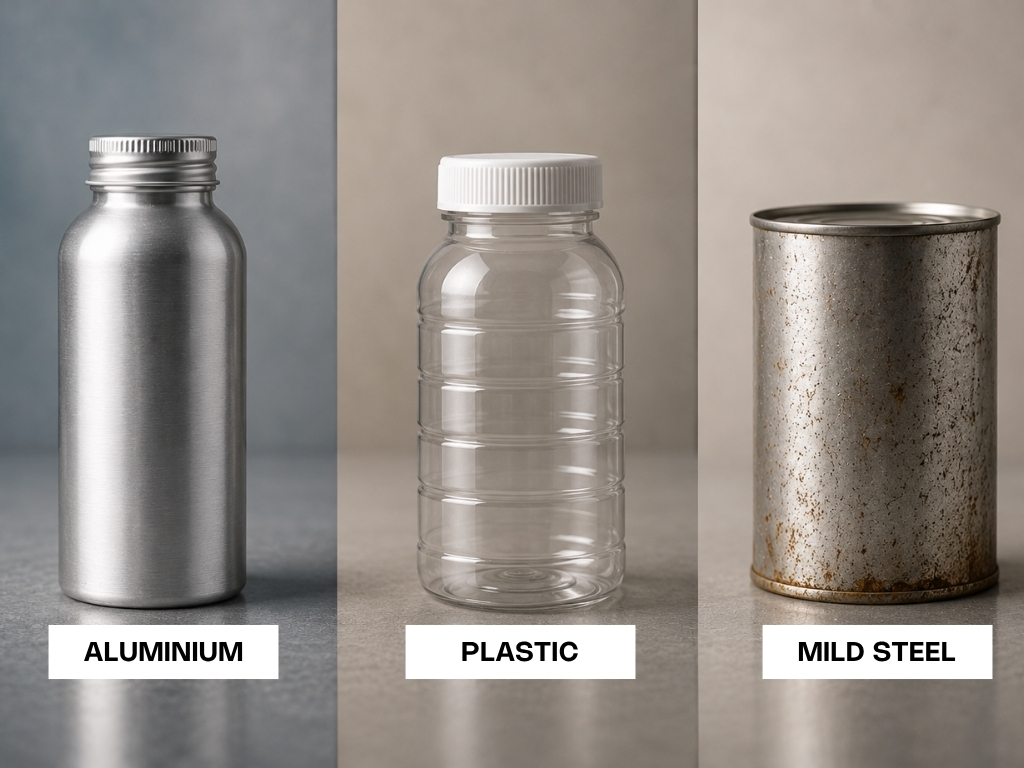
When choosing industrial packaging, the material matters just as much as the product inside. The right packaging protects product quality, reduces losses during transportation, meets regulatory requirements and supports long-term sustainability.
For decades, plastic and mild steel have been widely used across industries. However, manufacturers today are increasingly moving towards aluminium packaging because it offers better product protection, longer service life, improved sustainability and lower lifecycle costs.
At Al-Can, we have spent decades manufacturing high-quality aluminium bottles, containers, drums, and packaging solutions for industries worldwide. With exports to over 37 countries and four manufacturing facilities in India, we understand what businesses expect from industrial packaging: reliability, safety and consistent quality.
1. Why the Packaging Material Actually Matters
For flavour &fragrance, pharmaceuticals, agrochemicals, essential oils and specialty chemicals, the container isn’t just something to hold the product – it’s part of what keeps that product stable for its entire shelf life. A material that reacts with what’s inside it, lets moisture creep in or fails somewhere on a long export route can mean a failed batch, a rejected shipment or a product that’s already degrading by the time it reaches the customer. That’s why more buyers now think about packaging material at the formulation stage instead of leaving it for procurement to sort out later.
2. Aluminium vs Plastic vs Mild Steel: A Side-by-Side Comparison
Here’s how these three actually stack up on the things that matter most for packaging:
| Property | Aluminium | Plastic | Mild Steel |
| Barrier Protection | Blocks light, oxygen & moisture completely | Semi-permeable; gases and vapour pass through over time | Strong barrier, but heavy and rigid |
| Chemical Reactivity | Inert with/without proper internal coating; no leaching | Can leach plasticizers into contents | Prone to rust and corrosion without heavy coating |
| Manufacturing Process | Extruded or Deep-drawn (one piece), seamless — no weld line to fail | Blow-moulded or injected | Rolled and welded; the seam is usually the weak point |
| Weight | Lightweight; lowers freight cost | Lightweight | Heavy; raises shipping cost |
| Corrosion Resistance | Naturally corrosion-resistant; anodised for extra protection | Not applicable, but degrades under UV/heat | Rusts unless specially treated |
| Recyclability | 100% recyclable, infinitely, with no quality loss | Recyclable in limited cycles; often downcycled | Recyclable, but energy-intensive to reprocess |
3. Where Aluminium Pulls Ahead
The Barrier Plastic Doesn’t Really Have
Plastic looks sealed, but it isn’t, not entirely. Oxygen move through the polymer wall slowly over time which is exactly what degrades light-sensitive flavour & Fragrance, essential oils, etc oxidation-prone if they sit in it long enough. Aluminium doesn’t have that problem – nothing passes through the metal itself which is why formulators packing anything sensitive tend to end up here eventually.
Where Mild Steel Runs Into Trouble
Mild Steel drums hold their shape fine, but they rust, especially on humid export routes/conditions.
No Weld, No Weak Point
Most mild steel drums have a weld line or seam somewhere and that’s usually where leaks and contamination start first. Al-Can’s aluminium bottles and containers are extruded or deep-drawn from a single piece of virgin aluminium – no welds, no seams – so there’s no weak point built into the design to begin with.
Light Enough to Matter, Sturdy Enough to Survive Transit
Aluminium sits in a decent middle ground: light enough to make a real difference on freight costs for large export orders, but rigid enough to survive stacking, handling and long transit without denting or splitting the way plastic pails sometimes do.
More Than Just Recyclable
Plastic loses quality every time it’s recycled and a fair amount of it ends up downcycled into something else rather than reused for the same job. Aluminium can go through that cycle indefinitely without losing strength or purity, which is really what a circular economy is supposed to look like – not just a recyclability line on a data sheet.
Ready for Regulated Exports
UN-approved packaging isn’t optional, it’s a requirement. Al-Can’s aluminium containers are available with UN-approved certification for dangerous goods and every batch goes through dimension checks, leak tests, weight verification and internal cleanliness checks before it ships out.
4. Where Aluminium Packaging Is Used
- Agrochemicals & Specialty Chemicals — Corrosive solvents, pesticides and reactive chemical that would compromise a plastic or unlined mild steel container over time.
- Essential Oils, Flavours & Fragrance — Light- and air-sensitive aromatic compounds that lose potency in permeable plastic packaging.
- Export & Bulk Industrial Supply — Shipments where freight weight, corrosion resistance and UN-approved documentation all matter at once.
5. Why Buyers Trust Al-Can
Al-Can runs four manufacturing plants in India and exports to over 37 countries, which means the quality holds up across large production runs and not just one showcase batch. Every container starts as virgin aluminium, at least 99.5% pure, extrusion or deep-drawn seamless, made under ISO-accredited processes with UN-approved options available where regulated shipping calls for it. In industries where one bad container can mean a rejected shipment, that consistency is really what’s being sold.
Ready to Compare Aluminium Against Your Current Packaging?
If plastic’s degrading your formulation or mild steel’s driving up your freight bill, it’s worth putting aluminium head-to-head against what you’re using now. Get in touch with the Al-Can team to talk through capacities, customization and certification for your industry.
Frequently Asked Questions
Is aluminium packaging better than plastic for Flavour and Fragrance products?
In most cases, Yes. Aluminium is a complete barrier against oxygen, moisture and light, while plastic is permeable and can let sensitive formulations degrade slowly over time.
Is aluminium packaging more expensive than mild steel?
Not usually, once you look at the full lifecycle. Aluminium is lighter, so it costs less to freight and its corrosion resistance and reusability cut down on costs – often bringing the total cost below mild steel despite a higher unit price.
Can aluminium packaging be recycled like plastic and mild steel?
It can be recycled indefinitely without losing quality or purity, which plastic can’t really do – plastic degrades a little with each cycle and is often downcycled rather than reused for the same purpose.
What makes a seamless aluminium container different from a welded mild steel drum?
There’s no weld line. On a welded mild steel drum, that seam is usually the weakest point and the most likely place for a leak or contamination to start. A extruded or deep-drawn aluminium container doesn’t have one to begin with.
Is aluminium packaging suitable for export shipping of regulated goods?
Yes – Al-Can offers UN-approved aluminium containers and bottles for shipping dangerous goods across international borders.
Which industries benefit most from switching to aluminium packaging?
Mostly flavour & fragrances, essential oils, pharmaceuticals, agrochemicals and specialty chemical manufacturers – anything sensitive to oxidation, moisture or contamination sees the biggest benefit.

 info@alcanexports.com